How to price your game in 2025 and beyond


This guest post was written by IndieBI. The views, opinions, and information expressed in this article are solely those of the author and do not necessarily reflect the views of Unity Technologies. Unity does not guarantee the accuracy or completeness of the information provided by the author and is not responsible for any third-party content or links within this post. This content is provided for informational purposes only and should not be considered legal, financial, or professional advice from Unity.
There is no simple answer to pricing your game. But there are more questions.
For many premium game developers, the question of "how much should my game cost?" looms large as launch approaches. It’s a critical decision. It can feel overwhelming. And for good reasons too.
Pricing strategy is one of the more important factors deciding your game’s odds of commercial success, second perhaps only to the game itself. And while no individual pricing decision can salvage a bad game, you definitely can sink an otherwise good game with pricing mistakes.
However, while your initial price point is important, it’s just one piece of a much larger puzzle. True revenue optimization comes from a holistic strategy that extends far beyond the initial price tag. A strategy that’s best supported by obsessive monitoring and agile adjustments for months before and years after your initial release.
IndieBI helps developers and publishers track and optimize revenue for tens of thousands of games across all PC and console platforms and yet - the more data we give our models to crunch, the more we appreciate that important questions like these rarely have easy, cookie-cutter answers.
Even if your game is massively successful, poor pricing decisions and ineffective commercial management can be silently losing you hundreds of thousands of dollars a year.

So in short – setting a good pricing strategy is nuanced, takes time, and can’t be done in a vacuum. When figuring out your initial price point, it’s always smart to think much broader than that – to start from who and why will even buy your game, through your value proposition and messaging, all the way to how you’ll manage your game for years after release.
This guide might uncomfortably push your intuition of what it takes to make a commercially successful game. It doesn’t provide easy answers – rather, it aims to highlight some of the most important threads you should pull as you’re preparing to launch your game.
All of the detailed charts and figures in this article are compiled from anonymized historical performance of over 140,000 games, DLCs, and other products that IndieBI tracks on behalf of our clients across all PC and Console platforms. Remember that these generalized insights are useful and can help build good instincts, but your game is not every other game - use common sense and expect your mileage to vary.
The Foundation: Your Store Presence
Before a player properly considers your game's price, they encounter your store page. Your price does not live in a void, it’s an integral part of the story your store page is telling - from how you named your game, the assets you chose to represent it, how you talk about it in your copy and trailers, how much social proof you choose to lean on, all the way to how much care and effort you invested in localizations and collaborations.
Heaps and heaps of decisions go into making a great first impression. A lot of them extend beyond the store itself. How your game is streamed, reviewed, or how you’re building and engaging your community will also all have a compounding impact on your conversion rates.

You can’t control everything that happens outside of your store page, but you definitely can control a lot of what happens inside of it. Start with a little honest introspection:
Do you really understand your audience?
Everything on your store page should be crafted with your audience in mind. Or more critically – your game itself should be crafted with your audience in mind and your store page needs to reflect that.
What need or desire is your game fulfilling? Are you offering a power fantasy? An escape? A puzzle? A sense of joy and wonder? A way to spend time with friends? A new and unique gameplay experience?
Is your game telling story that your audience wants to see develop? Who and in what circumstances will want to play your game, rather than another round of Fortnite?
Understanding your core audience and the value you’re offering allows you to tailor the assets, communication strategy, and even pricing to reinforce those crucial "hooks" that give your visitors a reason to play your game.
The less clarity at this step, the higher the chance that your game will fail to communicate a distinctive identity and won’t stand out. Your price point won’t matter if your customers don’t get why they would spend time on your game, let alone money.
Funneling enough visitors to your store page to build momentum is important, but it can all be for nothing if the store page itself fails to resonate with your audience.

Go read Victoria Tran’s book if you’d like a different, concrete perspective – it’s a precious rare crash course on nurturing audiences and communities by a genuine practitioner (and an overall excellent human bean too).
Did you put enough care and love into your store assets and content?
Shipping any game is a huge achievement. Shipping a game that players genuinely love is basically a miracle. However, it can still be all yours to lose if your store page fails to convert!
You alone control your store presence – your key art, store capsules, screenshots, trailers, store copy, how you select your box quotes, and a hundred other things. They are the packaging for your product and they have basically one goal – give your audience a compelling reason to really want to play your game.
Your audience has to be excited to spend their time in your game. A Steam capsule that fails to stand out, a confusing screenshot, or a boring trailer can lose a potential buyer before they even look at your price.
The content of your assets still needs to clearly reflect the game itself. If your assets lie or mislead, your game will inevitably be crushed by disappointed reviews, refunds, and low playtime. But what you choose to highlight and focus on it is entirely up to you and your understanding of what will be the most compelling for your audience.
Make sure your store page is as great as your game, and don’t settle for your first attempt. You’ll find better ways to communicate with your audience as your game develops, so make sure to apply the learnings to your store pages as well.
Are you improving or falling behind?
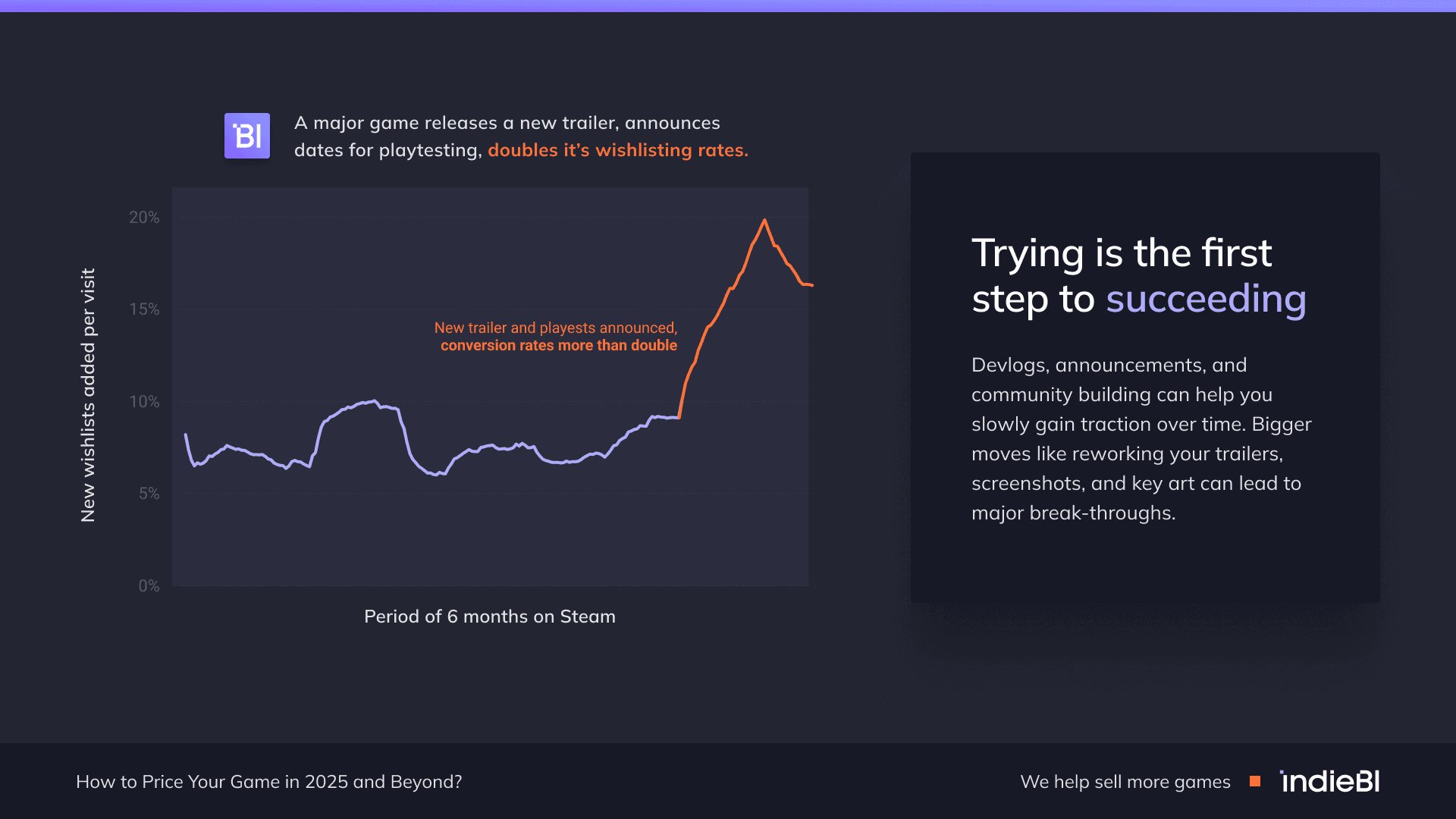
If you can spare the time and effort, it’s always best to iterate, iterate, iterate. Your first stab at screenshots and trailers might be fine, but it can probably be better. Sometimes in can be a lot better, even with relatively cosmetic tweaks.
In a case study published by Meta, the Quest store analytics team tracked a sample of games through a few A/B variants of store page assets. It documented big gains in conversions for games of all shapes and sizes. Especially for smaller games, the improvements were substantial.

Introducing clearer, more visually attractive assets boosted conversions by over 30% in some cases. This is a substantial improvement won on just cosmetics – without any deeper refinement of the underlying audience understanding or messaging.
Steam and other platforms haven’t made similar experiments quite as easy to run yet, but the main points remain universally true – spending time and effort to mindfully improve and iterate on your store assets pays dividends.
While you can’t A/B test store page variants easily, you can make time to refine your assets and messaging with every Next Fest demo and every play test. Track your click-through and wishlisting rates. Talk to your community.
Be honest to yourself about how much demand you’ve manage to whip up and keep striving for more before you launch – not just by making the game better on its own, but also by improving how confident you are in hooking and converting your audience.
Ultimately, how you choose your price is largely irrelevant if your store capsules don’t bring eyeballs to your store page, or if your assets fail to make your customers give a damn.
Even a perfectly priced game can still struggle to find an audience if it suffers from a poorly executed presentation. Invest in understanding your audience and find ways to get your players excited about your game. Keep honestly tracking and evaluating how much demand and traction you’re getting before release.
All of this will not just give you a much easier time when it finally comes to selecting a price point – it will also give your game a better chance of drawing a happy audience in general.
Still Got to Decide Somehow: The Price Itself
Once you really understand who your game is for and you have a crisp image of how it will be presented and received by your audience, you’re about as well equipped as you can be to start puzzling out your pricing options.
Which is to say – you still have lots of work to do, but at least you have a solid direction now. Deciding on your initial price point will ultimately be a judgement call, but find the time to list and consider a few key parameters and you’ll feel all the more confident to make it:
Competitive landscape – what’s your target audience up to?
1. Comparables – What other games do your customers buy and play? You almost certainly have a good intuition about it already, but it helps to really spend time, do research, and make a spreadsheet.
Review your competitors’ “more like this” sections, their genre and tag associations, their average playtimes, review scores, base price, discounting histories, regional performance. The homework you do here will help you find the boundaries of your niche and position your game within it. A tidy, complete list will help refine and ground your intuitions. And when the time comes to make a final call, it’ll make it much easier for you to decide if your price should follow the market or if you’d rather intentionally become an outlier.

The niche made up of your comparables will reflect your audience’s built-in pricing expectations. All else being equal, it’s good practice to start there and then refine.
2. Size and shape of your audience – Are you targeting a small niche with limited competition, or a huge audience that’s spoiled for choice? Are your players PC-only, or will they want your game on Steam Decks, Switches, mobiles, or consoles? A lot of this should be reflected in your spreadsheet from the previous point. The cluster of your comparables will overlap a lot with your understanding of your audience, but there’s a critical caveat: just because everyone in your niche priced their games a certain way doesn’t necessarily mean they’re right for your game.
Even the most successful puzzle games rarely break 2 million lifetime owners on Steam. If you believe you’ve made the best puzzle game of the decade, you probably still can’t expect to sell more than 2 million units – but you can set a higher price point than everybody else and sell those 2 million units slower, for more lifetime revenue. On the other hand, great crafting-survival games regularly cross 10 million units on PC and tend to be on the expensive side. If your game appeals to an audience as broad as that, you might be better off trying to compete on price, selling as many units as possible, fast and cheap, without worrying about saturating your market. Your game might be different in ways which your customers will happily pay more for, it might have more mainstream but price-sensitive appeal outside of the core audience of your competitors. Perhaps everyone in your niche so far was just plain wrong. Looking at comparables is important, but clearly understanding your audience for yourself is more important.
Your own game – what are your strengths?
3. Production values – Does your game look like a million dollars? Is it a magnum-opus you worked on for the last 10 years? Does the amount of effort and care you and your team put into the game really shine through in your store page and messaging? People will naturally expect higher prices for games which look or read like they took more effort and resources to make. If your game presents like it was cheap to make, you’ll probably want to err on the side of making it cheap to buy as well.
4. Playtime – How long does it take to beat or get bored of your game? While playtime is just another piece of the puzzle, it’s often downstream of both how big your game is and how fun it is to play. Customers are happier, leave better reviews, and are more likely to recommend games they spend more time playing. They are more likely to be disappointed and complain if they found a game too short or not engaging enough for a hefty price tag.Not every game needs to be dozens of hours long. Some games are exceptional experiences crafted into a tight few hours. But if your game isn’t quite that exceptional, and players drop it after only an hour or two, then a higher price tag will likely invite controversy, refunds, and eat into your momentum.
5. Network effects and upsell potential – Is the initial purchase the only thing that matters to you? Or do you have more ways in which each new player adds to your game’s commercial success?Multiplayer games benefit from having more players to fill lobbies, maintain a healthy playerbase, and invite others to play with. Friendslops under five bucks will see tons more gifting activity as people impulse-buy them for their entire friend group. Games with strong DLC or in-app economies will often see more revenue from upsell than from initial purchases. Sequels perform better if the original game sold more units recently, even if at a very steep discount.The more you value each of your players across all of your current and future products, the more you’ll likely want to consider a lower price point – prioritizing unit sales over initial revenue.
6. Traction and demand – Are there tens of thousands people waiting for your game before it’s released? And are they really there, or have they just wishlisted your game a year ago after your gif went viral and you haven’t really seen them since? Robust community playtesting, an ever-green Next Fest demo, or a strong pre-release Discord community are often much stronger demand indicators than just lifetime your wishlist balance. The older your wishlists, the less likely they are to convert. Players actively engaged in your community, playtesting your game, providing feedback and suggestions are an order of magnitude more likely to buy your game at launch than passive wishlisters from half a year ago.

Lackluster traction can rarely be salvaged by pricing alone – it might rather be an argument to delay your game and give yourself more time to find an audience. However, if delaying is not an option and you’re forced to ship and pray, then putting a high price tag on a game which is already starved for traction probably won’t help.
Your feelings – what does your heart tell you?
7. Premium price means ✨ premium game ✨ – Your pricing communicates your game’s ambitions and your own team’s perception of its quality.
Your audience will have a clear image of what to expect from a forty dollar game, and what to expect from a seven dollar game. Nothing is stopping you from pricing your game higher than everything else in your niche. It’s a bold strategy, but it is a choice you can make. And it can be effective at communicating that your game is an exceptionally premium experience in a space otherwise filled with cheaper products.
8. Fear of rejection – More pervasive than boldness, most of us live in ever more crippling anxiety and insecurity as our release dates approach. Launching your game only to have nobody play it is a nightmare scenario. This fear leads to many devs and publishers skewing towards lower price points, terrified of overpricing and alienating their audience, even if the game has the healthiest demand indicators in the world. However, on platforms with algorithmic visibility like Steam, your launch revenue often dictates how much exposure your game will receive from the platform moving forward. Underpricing a highly in-demand game from $24.99 to $19.99 might make you feel more comfortable, but it could also be silently erasing 20% of your launch revenue and initial visibility, suppressing your revenue prospects for months and years to come.

If your feelings tell you to price the game low but your data says it should go high, take a really deep breath and consider going with your data – you can always run deeper discounts later.
9. Greed isn’t always good – However, don’t assume that your customers aren’t price sensitive at all. A lot of your initial customers at launch will want to buy your game no matter the price point. They’ve been anticipating your release for a while, especially if they wishlisted recently or became engaged community members. The decision to buy your game is already made, as far as a lot of them are concerned.But price barriers and supply-demand curves do still exist. If a game gets priced much higher than expected, it will see some of its audience hold off until a deeper discount, or divert to Game Pass, torrents, or Twitch. At a high enough price point, even your most dedicated community members might be tempted to think again.

While a high-but-fair price tag will often lead to more lifetime revenue if supported by a strong commercial strategy, there is such a thing as greed. Overshooting on price can suppress launch sales and even alienate some of your core audience. A high price will lead to more of your audience wishlisting instead of buying. You can recapture some of those wishlisters later through strategic discounting, but some of them will be lost forever. If your gut, intuition, or Discord community tell you that the price you’re thinking of is a little on the spicy side, don’t ignore it.
Getting everything properly thought through, written down, and put into a spreadsheet will probably narrow down your choices to two or three price points. This is the judgement call part of the process.
Give yourself time to think your candidate price points through. Sleep on it. Consider if there are any other factors that are specific to just your game. Then go with what vibes best.
If the decision still isn’t clear, default to the highest price point you’ve considered. If you can’t find really good arguments to convince yourself to push it back down, then that’s likely your best bet at maximizing lifetime revenue. Your most engaged customers won’t mind if your game is a little more expensive, you can always capture the more price-sensitive ones with deeper discounts down the road, and the difference in revenue-per-unit can be a huge factor for your lifetime revenue potential.
Work’s Not Done Yet: Even More Decisions and Active Management
Congratulations! Now that you’ve decided on your initial price point, you’ve officially started to work on your commercial and pricing strategy.
Just around pricing alone, there are still more decisions you really should make before you release. And then there are more decisions that you should be continuously making and reviewing and making again for years after you’ve launched.
If you’re pressed for time, you can make the choice to skip this. It just won’t be a very good choice, and it may silently cost your game more than half of its total revenue potential.
Bows to tie before launch
The price point you established through all your previous effort is your initial base price. However, that’s not the only price point your game will be purchased at.
1. Localize and regionalize – On Steam, your USD price will likely only account for anywhere between 20% and 60% of your global revenue. A substantial chunk of your sales will come from markets with different regional currencies and different price points.

Currency exchange rates and purchasing power shifts all the time. Most platform’s regional pricing recommendations don’t keep up. If you follow Steam’s current defaults, you’ll be making your game about as expensive in Poland as in Norway. Grassroots initiatives like #PolishOurPrices are trying to highlight the issue by leaning on customer sentiment, but perhaps even more tangibly – fixing your regional pricing is an easy way to permanently increase your revenue.

Additionally, no cookie-cutter pricing matrix will ever take your game’s specific audience mix and strategy into account. Reviewing your regional wishlist splits and gameplay metrics to identify markets of interest is all up to you. Deciding how much to invest in localizing your store pages and assets for key regions is all up to you. Deciding which markets to intentionally underprice to boost presence is all up to you.
Spend time and effort to manually evaluate and adjust your regional pricing regularly, it’ll add up to substantial improvements in revenue and audience satisfaction.
2. Adjust for gray market – Inevitably, some of your customers will bargain hunt and look for your game on torrents and reseller websites. If your game becomes popular enough, professional gray market resellers will step in to service the demand. These resellers will buy up stock of your retail keys from third-party storefronts or they will buy your game directly on Steam and resell botted accounts if you don’t do retail. No matter what, these resellers will always buy up your game at the cheapest available price. You might not be able to stop them, but you can capture more of that gray market revenue for you and your team.

If you believe that the gray market will be a concern for your game, the least you can do is bring some of your cheapest regional price points up – resellers will still stock up on your game if it costs $4 in Kazakhstan instead of $2, but you will double your gray market take rate.
3. Create more price points – Some of your customers will be more price sensitive than others. Some will not be price sensitive at all. In a vacuum, you’d want your pricing to adjust to the maximum amount each individual customer actually wants to spend on your game. In practice you can’t do quite that (in part, because it’d be profoundly anti-consumer and probably a sin). What you can do is set up a more robust package or bundling structure and give your customers more options. Premium packages and bundles with extra content provide ways to spend more money for customers who aren’t price sensitive and want to support your game. Promotional bundles with other games and discounts give opportunities for better deals.Even a simple “supporter bundle” with a soundtrack or digital art book can help capture a couple extra percent of revenue. Cross-promotional bundles, if organized with strong games with a significant audience overlap, can grow your sales by more than ten percent. Good DLC bundles and premium editions often boost revenues by double that.

It will take time and effort to get your regional pricing, packages and bundles all setup and ship shape. But when done right, all of this can be a substantial multiplier to your game’s revenue potential.
In market as competitive as video games are right now, this might just be the make-it or break-it for your game – the difference between securing financial health for your team, or having to go back to your regular jobs in investment banking.
The reward for your success: more work, never ceasing
If you’ve done everything right, shipped an excellent game, found an enthusiastic audience and commercial success, then by all means - you’ve made it. You beat the odds. You should celebrate.
And once you’re done celebrating, more work begins. While your team is frantically patching bugs and improving your game, you should make time to start methodically tracking and optimizing your commercial performance.
By IndieBI’s estimates, the average publisher is leaving over 26% of their games’ potential revenue on the table due to mistakes and commercial inefficiencies after launch. For many games, this room for improvement is larger than that – some could see their revenue more than double.
It takes work but it’s well worth it, so make room in your life for:
1. Obsessive monitoring, experimentation, and adjustments – Step one to getting better is understanding how good or bad you already are.
Constant, in-depth monitoring of all of your business metrics should become your second nature. You need to be intimately aware of your sales, refunds, store page conversions, wishlist dynamics, promotional uplifts, regional splits, customer sentiment. A clear-eyed understanding of your game’s commercial performance is a necessary foundation to improve over time.
Once you’ve got your business intelligence all sorted out, you can start making a habit of hunting down potential opportunities, experimenting, and adjusting your strategy accordingly. That bundle you set up at launch not making any money? Retire it and try a different one. Your click-through rates feeling a little low? Test a new set of capsules for a few weeks. Sales in China underperforming? Try tweaking your regional pricing and updating your localization.

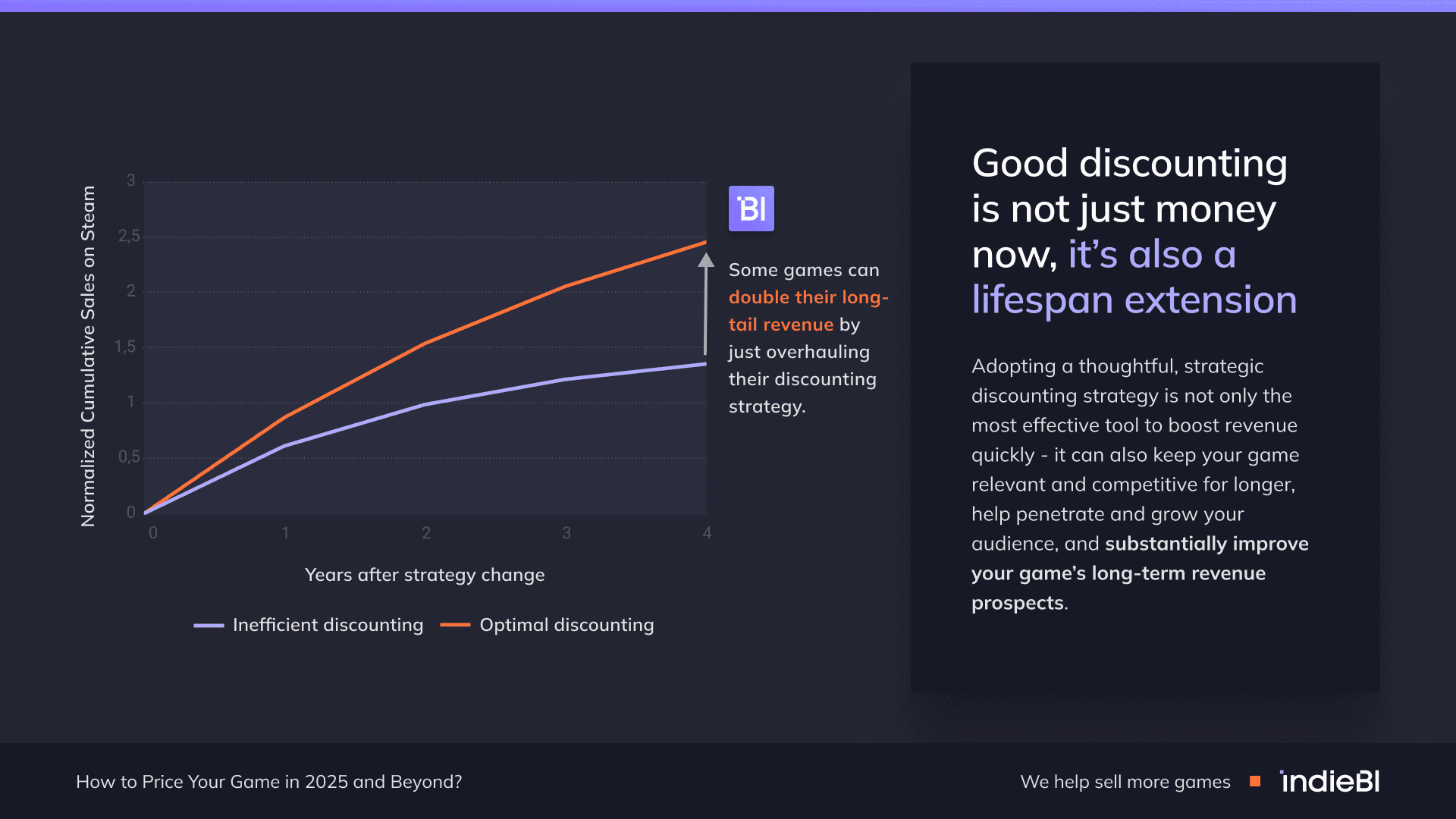
2. Active discounting and price management – Now that you’ve launched, your discounts will start accounting for more and more of your revenue. Platforms like Steam and Switch reward discounts with extra visibility, and customers universally like a bargain. Discounting will quickly become the single most powerful tool for optimizing your game’s revenue. It takes consistent monitoring of how each of your promotions perform, how your store pages convert, and how your wishlists activate. It requires constant adjusting to make sure your discounting schedule is optimized and supports your content releases and marketing plans. Missing out on a discount by mistake or human error can mean tens of thousands of dollars of lost revenue. Picking a bad discounting depth strategy for your DLCs might eat a third of their sales.
A well planned and executed discounting strategy can account for significantly more than half of your game’s entire lifetime revenue.
3. Regional awareness – Paying special attention to your regional metrics can unlock entire markets for your game well after launch.
Even for countries where you don’t speak the language, your metrics alone are often excellent leads for further investigation. Once you know where to look, translating refund reasons and reviews, researching regional forums, or asking your community will often unearth very solvable issues.
Find them, fix them, make an entirely new audience for your game very happy.

4. Big platform and DLC moves – If your game is great, it’s never too late to grow your audience.
Generally speaking, the sooner you can afford to make all of your major content plays, the better. Ports work best if available at launch. The sooner you ship your DLCs, the more time they have to generate revenue. The faster you add content or modding support to your game, the more rapidly your conversion rates and sales will grow.But even if it takes you years to ship a port or a DLC, it can still be very worth it. Launching a set of good DLCs can often more than double your game’s revenue moving forward.

Producing a great console port can be expensive and technically complex, but it substantially boosts your long-tail revenue and opens an entirely new audience for your current and future games.

Maintain a solid understanding of your business metrics and your audience, and you shouldn’t have a hard time calling the right shot here.
Your work in revenue optimization will likely be the most critical factor for your team’s financial health for years after launch. Being diligent and effective about post-launch management will make a huge difference.
It will impact not just to the popularity and financial success of your current game, but also how well you’re set up for your next game – how much runway you have to fund your next project, and how big and how happy of a community you captured as an audience for your future games.
At IndieBI we’ve been helping developers and publishers manage games grossing billions of dollars a year across all platforms. We’ve seen first-hand how transformative smart revenue optimization can be – both for the bottom line of their businesses, as well as for the health and growth of their audiences.
Be a little obsessive, keep track of how you’re doing, and never stop improving.
So - how should you price your game in 2025?
In a word, thoughtfully.
The market is ruthlessly competitive, and it keeps getting more and more crowded with each new release. Shipping a great game may have been enough to guarantee commercial success a few years ago, but it’s just table stakes now.
Making a fantastic game should now be seen as just one piece of a larger puzzle. It is still the absolute most important piece, but needs to be surrounded by other pieces – including a robust pricing and commercial strategy – or it risks sinking like a stone shortly after launch.
In conclusion, while setting an initial price is a fundamental step, remember that it takes way more than one step to finish a race. Your game's commercial success hinges on a cohesive strategy that encompasses a compelling store presence, intelligent regionalization, smart bundling, and – most importantly – a commitment to continuous monitoring, evaluation, and agile adjustment.
Approach your game's commercial lifecycle with this holistic mindset and an eye for data. You'll be far better positioned to unlock its full revenue potential. You’ll improve faster and you’ll sell more games.
Built by game developers, for game developers. IndieBI is the revenue analytics platform we always wished we had. It turns complex sales data from Steam and other platforms into accessible, actionable insights. Join hundreds of studios and publishers tracking billions in sales on the IndieBI data platform - or have us manage and boost your games' revenue for you, like we're already doing for over a thousand games across all platforms. IndieBI is free to start for everyone and free forever for small teams.